
Tax administrations decide who to audit through compliance risk management: a structured way of finding where non-compliance is most likely and most costly, ranking those risks, and choosing the right response to each. Audit is only one of those responses, and often not the first.
No administration can examine every taxpayer. Compliance risk management is how it decides where limited staff, time and data will recover the most revenue and improve compliance the most.
What is compliance risk management?
Compliance risk management, often shortened to CRM, is a methodology used to identify compliance risks within the taxpayer population and to focus resources on the highest risks to the tax base.[1]
It covers the four basic obligations every taxpayer has: registering, filing on time, reporting correctly and paying on time.[1] A risk can sit in any of the four. A business that never registers, a company that files late every year, a sector that consistently under-reports sales and a group of taxpayers that build up arrears are all compliance risks, and each calls for a different response.
The approach is widely adopted. Around 85% of the administrations covered in the OECD’s Tax Administration 2024 report say they have a formal compliance risk management strategy.[2]
Why not simply audit more?
Because audit is the most resource-intensive response an administration has, and because many compliance problems are not caused by deliberate evasion.
The IMF is explicit that compliance risk management is much more than audit case selection.[1] Its treatments range across three types:[1]
- Preventative: education, and reminders before filing deadlines.
- Facilitative: pre-filled returns, guidance written for specific industries, and chances for taxpayers to correct their own mistakes.
- Enforced: audits, investigations and penalties.
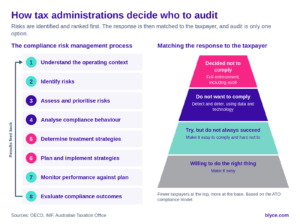
A widely used way to match the treatment to the taxpayer is the compliance model developed by the Australian Taxation Office. It is drawn as a pyramid. The base, and largest group, is taxpayers who are willing to do the right thing, and the strategy for them is to make compliance easy. Above them are those who try but do not always succeed, where the aim is to make it easy to comply and hard not to. Above them are those who do not want to comply, where the strategy is to detect and deter non-compliance using data and technology. At the top, and smallest, are those who have decided not to comply.[3]
Audit and the strongest enforcement tools sit mainly toward the top of the pyramid. Using them across the whole population spends the most expensive tools on the people least likely to need them.
How does the compliance risk management process work?
The OECD process, first set out in 2004 and still used as the reference model, has eight steps:[1][2]
- Understand the operating context
- Identify risks
- Assess and prioritise risks
- Analyse compliance behaviour, including its causes
- Determine treatment strategies
- Plan and implement those strategies
- Monitor performance against the plan
- Evaluate compliance outcomes
The last step feeds back into the first. A treatment that did not change behaviour shows up in the next round of risk identification.
Two documents usually come out of the process. A compliance risk register records the important risks and their ratings, and is updated as they change. A compliance improvement plan sets out how each approved risk will be treated.[1]
How are compliance risks ranked?
Risks are rated on two questions: how likely the non-compliance is, and how much it costs if it happens. A sector with widespread but small under-reporting and a handful of large taxpayers with complex structures can both rank high, for different reasons.
Ranking is what makes the process useful. It turns a long list of possible problems into a short list the administration has the staff to act on, and it gives leaders a way to link each priority risk to the resources assigned to it and to report that link to government.[1]
Where does the data come from?
The starting point is the administration’s own data: registrations, returns, payments and the results of past audits. Beyond that, administrations draw on external sources such as banking, company registry and customs data.[1] Information received from other tax administrations through automatic exchange of information is another source.
The IMF warns that more data are not always better.[1] What matters is having the right data, of reliable quality, and the capacity to analyse it. Its 2024 technical note on analytics for compliance risk management comes with a toolkit covering three practical areas: compliance planning, taxpayer profiling and audit case selection.[4]
How is compliance risk management assessed?
The Tax Administration Diagnostic Assessment Tool, known as TADAT, assesses it as part of its second performance outcome area, effective risk management. Three indicators cover compliance risk:[5]
- identification, assessment, ranking and quantification of compliance risks
- mitigation of risks through a compliance improvement plan
- monitoring and evaluation of compliance risk mitigation activities
Our guide to the TADAT assessment explains how these scores are given.
Where administrations commonly fall short
Preliminary research by the African Tax Administration Forum, drawing on TADAT assessments of 42 African tax administrations, identified a consistent pattern:[5]
- heavy reliance on internal information and taxpayer declarations, with little use of third-party data
- risk management used mainly to generate audit cases rather than to assess taxpayer risk
- risk management not part of a structured multi-year strategy
- monitoring of whether treatments worked almost non-existent
The last point matters most. Without evaluation, an administration cannot tell whether its treatments changed behaviour or only produced assessments.
Progress is possible within a few years. Fiji’s 2025 TADAT assessment found that the use of data for profiling and risk assessment had improved, supported by a detailed multi-year compliance improvement plan, while audit coverage and data integrity remained areas for development.[6]
What compliance risk management means for a small administration
The full process can look like a framework built for a large administration with a dedicated analytics unit. The IMF’s guidance is more practical than that.
Start small. A team of two or three people is enough to begin, and simple tools such as spreadsheets can support the early work. Automation and machine learning can follow as capability grows.[1]
Start with the data already held. Early-stage administrations are advised to use the data available, test anomalies through pilots and engage development partners, treating the full model as an end state rather than a starting requirement.[1]
Adapt the structure. The IMF notes that very small administrations may need structures different from the standard model.[1] In practice the same few people may identify risks, design treatments and carry them out.
Measure the outcome, not the activity. The number of audits completed says little on its own. What matters is whether filing, payment and reporting compliance improved in the areas targeted. In the African research above, it was the step most often missing, and it is the one that shows whether the effort was worth it.
Support is available. The IMF, the Inter-American Center of Tax Administrations and the European Commission all publish practical guidance, and the CIAT handbook was developed with input from administrations including the Barbados Revenue Authority.[7] For the wider picture of how administrations raise compliance, see how governments increase tax compliance.
