
Yes, on the problem it was built to solve. Since automatic exchange of information began, less money has been hidden in foreign bank accounts, and OECD research, academic studies and the EU Tax Observatory all point the same way. The reduction is partial, though, and some money has moved to places the standard does not reach.
For a tax administration, the benefit is not automatic. Receiving the data is one step. Turning it into revenue depends on what the administration does with it.
What is automatic exchange of information?
Automatic exchange of information is the annual exchange of financial account information between tax administrations under the Common Reporting Standard. Financial institutions collect information on accounts held by people and entities resident abroad and report it to their tax administration. The administration then sends it to the administrations of the account holders’ countries of residence, where an exchange relationship is in place. Unlike exchange of information on request, no one has to ask first.
By early 2026, 129 jurisdictions had committed to automatic exchange of information, and 116 of them had already begun exchanging.[1] Developing countries made up 54 of the 129, and 41 of those were already exchanging.[2]
How much information is exchanged?
In 2024, information on 171 million financial accounts was exchanged, covering almost EUR 13 trillion in total assets.[1]
Since 2009, Global Forum members have identified at least EUR 135 billion in additional tax revenue through transparency and exchange of information. Developing countries identified EUR 48 billion of that total, and accounted for 70% of the EUR 4 billion identified in 2024.[2]
These are amounts identified, which is not the same as amounts collected. They also cover exchange of information and related measures in general, not automatic exchange alone.
Has it reduced offshore tax evasion?
Three independent lines of evidence say it has.
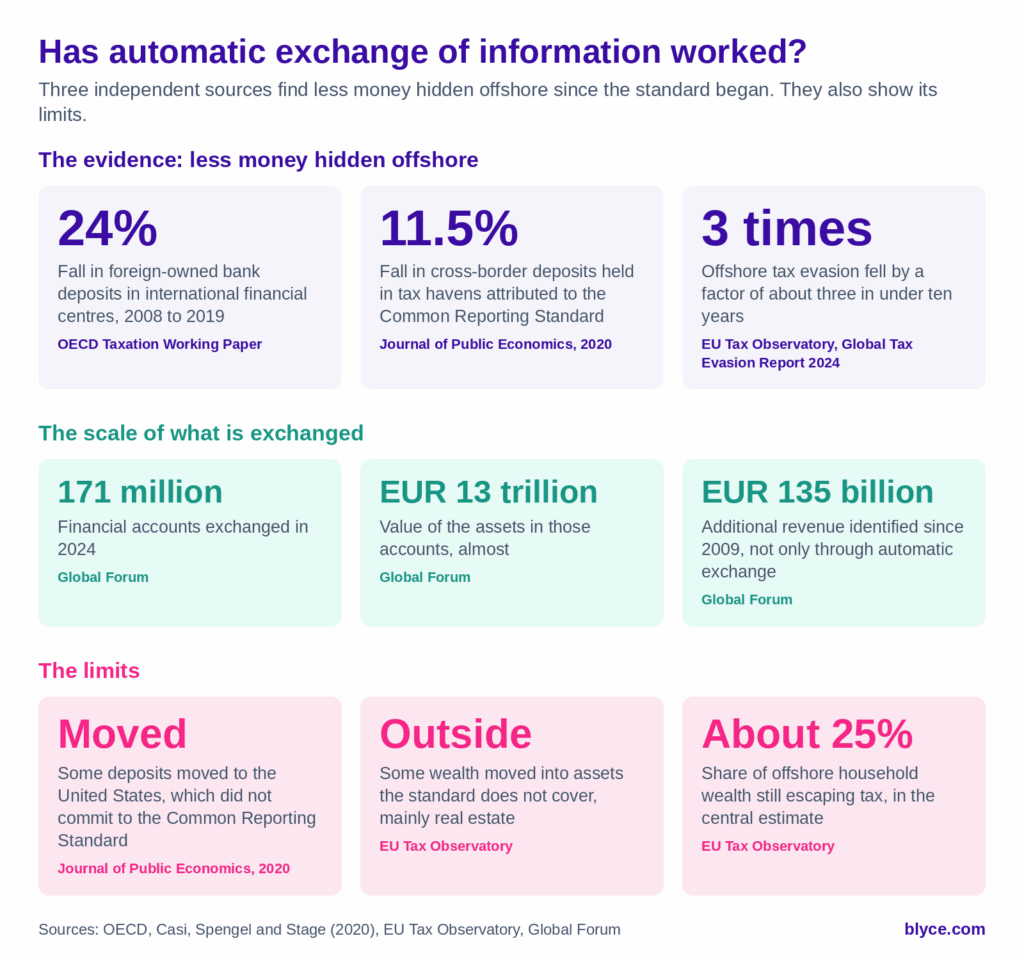
OECD research. Foreign-owned bank deposits in international financial centres fell by 24%, or USD 410 billion, between 2008 and 2019. The start of automatic exchange was associated with an average reduction of 22% in those deposits.[3]
Academic research. A study in the Journal of Public Economics found that the Common Reporting Standard led to an 11.5% reduction in cross-border deposits held in tax havens.[4]
The EU Tax Observatory. Its Global Tax Evasion Report 2024 found that offshore tax evasion declined by a factor of about three in less than ten years, and attributed the change to automatic exchange of information.[5]
Hiding money in a foreign bank account is harder than it was before the standard existed.
What are the limits of automatic exchange of information?
Some money moved instead of declining. The United States, which did not commit to the Common Reporting Standard, emerged as an attractive location for cross-border deposits.[4]
Some assets sit outside the standard. Some holders have moved into assets the standard does not cover, mainly real estate.[5] Crypto-assets were also largely outside it, the gap the Crypto-Asset Reporting Framework is designed to close.
Offshore wealth has not shrunk. Offshore household financial wealth is still around 10% of world GDP, about the same as before 2013. What has changed is how much of it escapes tax: about a quarter, in the EU Tax Observatory’s central estimate.[5]
Compliance by financial institutions is uneven. Some offshore institutions may not fully comply.[5] The Global Forum’s 2024 review found that further efforts were needed to make the standard effective, particularly in its implementation by reporting financial institutions.[6] That is now a focus of Global Forum peer reviews.
What does a tax administration need to benefit from the data?
The global effect, less money hidden offshore, does not by itself raise revenue in any one country. That depends on what each administration does with the records it receives. Developing countries in particular face challenges in using and interpreting the data, and dedicated support exists for it.[7]
Matching records to taxpayers. Each record arrives with the account holder’s name, address and, where available, taxpayer identification number and date of birth. It has to be matched to a taxpayer in the domestic register. Where identification numbers are missing or wrong, matching becomes manual work, and records that cannot be matched cannot be used.
Deciding which records to act on. Even a small jurisdiction can receive more records than its staff can review one by one. Ranking them, by account balance, by income reported, or against what the taxpayer has declared, decides where limited compliance capacity goes.
Following up. A record that points to undeclared income is useful only if someone acts on it, through a letter, an audit or a voluntary disclosure programme. That work competes with everything else a compliance team does.
Protecting what arrives. An administration must meet the Global Forum’s confidentiality and data safeguards standard to receive the data, and must keep meeting it. A failed assessment can suspend the flow of data.
Checking what is sent. Jurisdictions that host financial institutions also have to make sure those institutions report completely and correctly. That is where the Global Forum’s attention has moved.[6]
In a small administration, the same few people often do all of this, alongside other responsibilities.
Conclusions
It has worked on its own terms. Hiding money in foreign bank accounts is harder than it was, and evidence from different sources agrees.
It has not ended offshore evasion. Money has moved to jurisdictions and assets outside the standard, and the share of offshore wealth that escapes tax is lower but not zero.
The return to each administration depends on the administration. Matching, prioritising and following up on the records received, and keeping the security standard that allows them to arrive, decide whether the data turns into revenue.
