
No tax administration can audit its way to compliance.
There are not enough auditors in any country on earth to check every return, chase every late payment, and find every unregistered business. In a small state with fewer than a hundred staff in the entire administration, there are nowhere near enough.
Yet in well-functioning systems, the overwhelming majority of tax revenue arrives without a single enforcement action. People register, file, report, and pay because the system makes it reasonable to do so.
That is what tax compliance actually is, and protecting it is the central job of every tax administration. This article explains how compliance is defined and measured, why the gap is widest in the countries least able to absorb it, and the four levers governments actually use to close it.
What tax compliance actually means
Tax compliance is often talked about as one thing. In practice it is four separate obligations, and a taxpayer can fail at any of them independently.
- Register with the tax administration when required
- File returns on time
- Report accurately what is owed
- Pay on time
A business that files punctually but understates its revenue is non-compliant. So is a citizen who reports honestly but pays late, and so is an enterprise that never enters the register at all. Each failure has a different cause, and each responds to a different remedy.
This distinction matters because it is where measurement begins. Every serious attempt to improve compliance starts by asking which of the four obligations is breaking down, for whom, and why.
The tax gap: how compliance is measured
The standard measure of compliance is the tax gap: the difference between the tax that should be collected under the law and the tax that is actually paid, voluntarily and on time.
The gap is normally split into three parts, which map onto the obligations above.
Component | What it means |
|---|---|
Nonfiling | Tax owed by those who never filed |
Underreporting | Tax understated on returns that were filed |
Underpayment | Tax reported correctly but not paid on time |
Underreporting is usually the largest and the hardest to see. A taxpayer who never files is at least visible as an absence. A taxpayer who files and understates looks compliant.
The gap is not evenly distributed
IMF research decomposing tax gaps across country groups finds that the compliance gap is markedly higher in low-income developing countries than in other country groups.[1] This is the part rarely said plainly: the administrations with the least capacity to close the gap are the ones carrying the largest one.
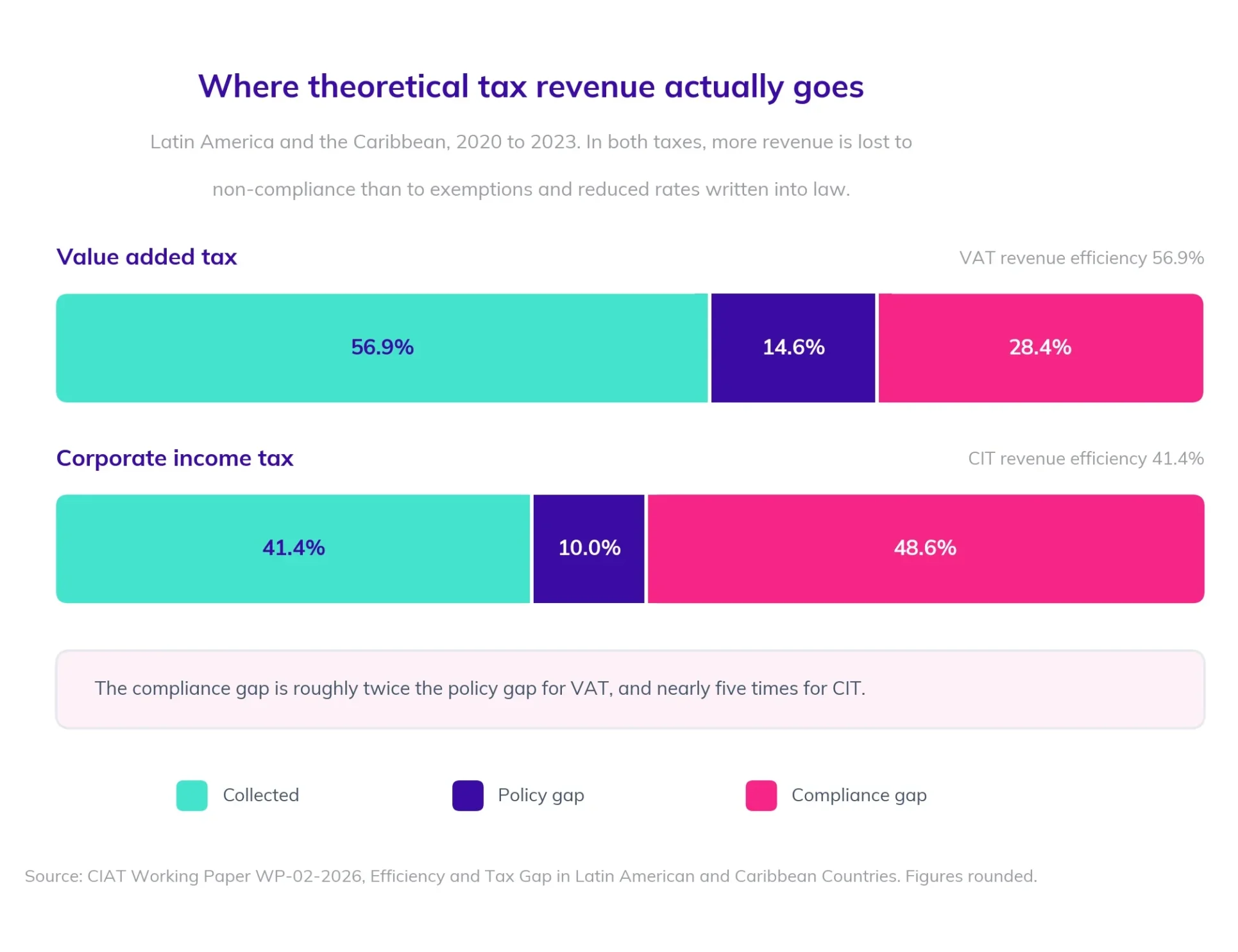
The regional evidence is more specific. A 2026 CIAT working paper estimating tax efficiency across Latin America and the Caribbean put VAT revenue efficiency at 56.9 per cent for 2020 to 2023.
Of the shortfall, 14.6 percentage points were attributable to the policy gap, the exemptions and reduced rates written deliberately into law, and 28.4 percentage points to the compliance gap.[2]
Why small administrations carry this more sharply
An IMF review of tax administration across the Caribbean found that reform had been slowed by a common set of conditions: organisational inefficiencies, pervasive data integrity issues, out-of-date processes, and low capacity, together producing a widening compliance gap.[3] Eight of the twenty administrations reviewed had fewer than one hundred staff in total.[3]
The same review identified where the problem starts. On-time filing rates across all taxes sat below international standards, and performance in this area was strongly affected by the low quality of the taxpayer register.
Large numbers of ceased or terminated taxpayers who should have been deregistered were still counted as potential filers, distorting every compliance measure built on top of them.[3]
It also found that compliance management in the region was more intuitive than fact-based, with limited measurement of compliance gaps or taxpayer attitudes.[3]
Read together, those findings describe a sequence rather than a general weakness. When the register is unreliable, filing rates cannot be measured accurately.
When filing rates cannot be measured, risk cannot be targeted. When risk cannot be targeted, scarce staff are spent on the wrong cases. The compliance gap that appears at the end of that chain begins at the start of it.
What closing it is worth
For small and developing economies the sums involved are not marginal. The IMF estimates that a 9 percentage point increase in the tax-to-GDP ratio is feasible in developing countries through a combination of tax system reform and institutional capacity building.[1] For low-income developing countries, where tax-to-GDP clusters around 10 per cent, that is close to a doubling of domestic revenue.[1]
The threshold effects are documented. World Bank analysis finds that moving from a tax-to-GDP ratio of 7 per cent to 15 per cent is associated with an additional 10 percentage points of cumulative growth over the following decade.[4]
In a small state, the revenue that closing the compliance gap would release is not a rounding adjustment to the budget. It is the difference between a government that can fund its own priorities and one that cannot.
Why enforcement alone cannot close the gap
Given a gap that size, the instinct is to enforce harder. The arithmetic does not allow it.
Audits are expensive, slow, and scarce. An administration that audits even a few per cent of returns in a year is working hard. In an administration with fewer than a hundred staff covering every tax type, every process, and every taxpayer, audit capacity is a rounding error against the size of the gap.
The proportions make this concrete. Where voluntary compliance is measured, it carries the overwhelming share of revenue. The United States, which publishes one of the most detailed tax gap estimates in the world, puts its voluntary compliance rate at 85 per cent.[5] Even in the best-resourced administration on earth, enforcement is working at the margin of a system that mostly runs on people complying by themselves.
So the goal of a modern tax administration is not to catch more people. It is to protect and grow voluntary compliance, so that enforcement can concentrate where it is genuinely needed.
Seen this way, every choice an administration makes, how easy it is to register, how long filing takes, how consistently rules are applied, how visible evasion is, either strengthens or erodes the willingness of the compliant majority to keep complying.
That is also why compliance is administrable at all. Governments cannot legislate willingness. They can build systems that make compliance the path of least resistance.
The 4 levers governments actually use
Across countries and decades, the interventions that measurably move compliance fall into four groups.
Lever | What it targets | Typical measures |
|---|---|---|
Make it simple | The cost of complying | E-filing, pre-filled returns, plain-language rules, one registration |
Make it visible | The odds of being seen | Accurate registers, third-party data, cross-checking between authorities |
Make it fair | The willingness to comply | Consistent treatment, working dispute channels, visible use of revenue |
Make it credible | The consequence of not complying | Graduated penalties, collection that follows through |
Make it simple. Compliance has a price even for the honest: hours spent, forms understood, offices visited. When that price is high, marginal taxpayers drop out, and in economies with large informal sectors they drop out in numbers.
The clearest global shift of the past decade has been here. Across 58 jurisdictions surveyed by the OECD, e-filing rates rose by between 18 and 24 percentage points over ten years across the three main tax types, and filing electronically is now the norm rather than the exception.[6] In-person contacts fell by 56 per cent since 2014, while online contacts tripled since 2018 to more than 3 billion in a single year.[6]
Taxpayers did not become more virtuous in that decade. Complying became easier.
Make it visible. People report more accurately when they know the administration can see what they earn. This begins with the register. An administration that cannot say reliably who is active, who has ceased trading, and who is obliged to file for which tax cannot target anything that follows.
From there, visibility is built by third-party reporting, employers reporting wages, banks reporting interest, customs reporting imports, and by cross-checking between government authorities.
A business that is invisible to the tax authority is rarely invisible to every authority. Visibility converts enforcement from an expensive search into a targeted response, which is what makes it viable at small scale.
Make it fair. Compliance is also a judgement taxpayers make about the system itself. Where rules are applied inconsistently, where disputes disappear into silence, or where citizens see little connection between taxes paid and services delivered, willingness erodes in ways no penalty schedule can repair.
This is the compliance dimension of the social contract, and it is why service quality and dispute resolution are treated as core compliance functions in modern assessment frameworks, not as courtesies.
Make it credible. Voluntary compliance survives only if non-compliance has consequences.
The compliant majority needs to see that the minority does not simply get away with it.
Credibility does not require harshness. It requires follow-through: penalties that are proportionate and predictable, arrears that are actually pursued, and enforcement concentrated where risk is highest rather than where collection is easiest.
None of these levers works alone. Simplicity without credibility invites abuse. Enforcement without fairness breeds resistance. The systems that sustain high compliance pull all four together, and they treat the administration itself, not the taxpayer, as the variable that can be improved.
The Evidence That Administration Quality Moves Compliance
For a long time, the link between administration quality and compliance was an article of faith among practitioners. It is now measurable.
Administrations are assessed internationally through TADAT, which scores performance across nine outcome areas and produces a comparable picture of where an institution stands.
IMF research combining those assessment scores with VAT compliance gap estimates found a robust negative relationship between administrative effectiveness and the size of the gap.[7] Better-run administrations collect more of what they are owed, and the effect is large enough that finance ministries measure it in fractions of a percentage point of GDP.
That relationship is the empirical answer to a question practitioners have argued about for decades. It is no longer a matter of professional conviction that administration quality moves revenue. It is measurable, and it moves in the direction the four levers predict.
What this means for Governments
Four conclusions follow from the evidence.
- Compliance is an outcome of design, not a trait of taxpayers. The same population complies at different rates under different administrations. When the gap widens, the productive question is not what is wrong with taxpayers, but which of the four obligations is failing and which lever addresses it.
- The register is the foundation everything else stands on. Filing rates, risk targeting, enforcement selection, and every compliance statistic an administration reports are all built on knowing accurately who exists and what they owe. Where that base is weak, the measures above it are unreliable in ways that are easy to miss and expensive to carry.
- Measurement precedes improvement. An administration that does not know its gap, or which component of it dominates, is choosing interventions blind. The tax gap and structured assessments like TADAT exist precisely so that scarce effort can be aimed.
- Administration is fiscal policy. The evidence now supports what practitioners long assumed: improving how a tax administration performs raises revenue, measurably, without touching rates. For governments facing pressure on budgets and resistance to new taxes, the most available money is often the money already owed.
No one enjoys paying taxes. A system does not need them to. It needs registering, filing, reporting, and paying to be simple enough, visible enough, fair enough, and credible enough that complying remains what most people simply do.
That is not a slogan. Measured across countries, it is how the revenue arrives.
Common Questions About Tax Compliance
Tax compliance means meeting four distinct obligations: registering with the tax administration when required, filing returns on time, reporting income and liabilities accurately, and paying tax on time. A taxpayer can fail at any one of these independently, and each failure has different causes and different remedies.
The tax gap is the difference between the tax legally owed and the tax actually paid voluntarily and on time. It is typically broken into three components: nonfiling, underreporting, and underpayment. It is also commonly separated into a policy gap, caused by exemptions and reduced rates written into law, and a compliance gap, caused by non-compliance.
IMF research finds the compliance gap is markedly higher in low-income developing countries than in other country groups. Contributing factors identified in regional reviews include data integrity problems, outdated processes, limited administrative capacity, and unreliable taxpayer registers, all of which weaken the ability to measure and target non-compliance.
Voluntary tax compliance is tax paid on time without enforcement action by the administration. It carries the overwhelming share of revenue in functioning systems. The United States, which publishes detailed estimates, puts its voluntary compliance rate at 85 per cent, meaning most revenue arrives because taxpayers comply on their own rather than because they were caught.
Because enforcement capacity is small relative to the taxpayer population. Audits are costly and slow, and no administration can examine more than a small fraction of returns. In small administrations, some with fewer than one hundred staff in total, audit capacity is negligible against the size of the gap. Enforcement works best as a credible backstop that protects the willingness of the compliant majority.
The evidence points that way. Electronic filing lowers the cost of complying, reduces errors, and creates data the administration can cross-check. Across 58 jurisdictions surveyed by the OECD, e-filing rates rose between 18 and 24 percentage points over a decade, and the shift away from in-person channels has been substantial.
TADAT, the Tax Administration Diagnostic Assessment Tool, is an international framework that assesses tax administrations across nine performance outcome areas, including registration integrity, risk management, timely filing and payment, accurate reporting, and dispute resolution. IMF research using TADAT scores has found that administrations with stronger assessments have measurably smaller compliance gaps.
IMF analysis estimates that a 9 percentage point increase in the tax-to-GDP ratio is feasible in developing countries through tax system reform and institutional capacity building. Separately, IMF research using TADAT scores found that improving an administration’s assessment from roughly a D+ to a C+ is associated with an additional 0.6 percentage points of VAT revenue as a share of GDP.
Footnotes
[1] Building Tax Capacity in Developing Countries, Staff Discussion Note SDN/2023/006 — International Monetary Fund
[2] Efficiency and Tax Gap in Latin American and Caribbean Countries: Value Added Tax and Corporate Income Tax, Working Paper WP-02-2026 — Inter-American Center of Tax Administrations (CIAT)
[3] Tax Administration Reforms in the Caribbean: Challenges, Achievements, and Next Steps, Working Paper WP/17/88 — International Monetary Fund
[4] Taxing for Growth: Revisiting the 15 Percent Threshold — World Bank
[5] The Tax Gap — Internal Revenue Service
[6] Tax Administration 2025: Comparative Information on OECD and other Advanced and Emerging Economies — OECD
[7] Closing the Gap: How Tax Administration Performance Shapes Compliance, Working Paper 2025/209 — International Monetary Fund
