
Data integrity in social security means that every insured person and employer is recorded once, correctly, and kept up to date. It matters because benefits are calculated from records built up over a whole working life. An error made at registration can surface decades later as a pension paid at the wrong rate, a contribution that was never credited, or a payment to someone who has died.
For a social security institution, the registration database is not a back-office detail. It is the record of what every member has paid in and is owed.
Why is data accuracy so important for social security administration?
Because a social security record is a lifetime account. The International Social Security Association (ISSA), the global body for social security institutions, sets out that each new member should receive a unique identifier and that member information should be kept current, so the institution can record contributions and benefits over the member’s whole life.[1]
When that record is wrong, the error cuts both ways:
- Members lose out. Contributions that are not credited, or credited to the wrong person, can reduce or deny a benefit the member has earned.
- The fund loses out. Duplicate records, outdated details and deaths that are not recorded lead to payments that should not be made.
Both damage trust in the scheme, and both are much harder to correct years later than at the point of registration.
What goes wrong when registration data is weak?
Public audits in the Caribbean show the pattern clearly.
Records that cannot be found. A forensic audit of Guyana’s National Insurance Scheme found that, for 2012, 213 of 383 claims records requested, or 56%, could not be located. Auditors also lacked the information needed to check whether some benefit amounts had been calculated correctly.[2]
Contributions that are not tracked. Jamaica’s Auditor General reported that the National Insurance Scheme did not have an effective system to account for employers’ contributions, and had not accounted for outstanding employer contributions of J$2.95 billion at March 2015. The report warned that delinquent employers might be overlooked and that contributors’ rights to benefits might be denied.[3]
Deaths that are recorded late. Barbados’s National Insurance Scheme has explained that it relies on information from the civil registry and on relatives to learn of a death, and that pensions are paid until it is notified. An Auditor General’s report identified 10 people, out of almost 100,000, whose families had received payments for a few months after they died.[4] The numbers were small, but the cause is one many schemes share: the scheme learns of a death only when someone tells it.
None of these are failures of technology alone. They are failures of how data is captured, matched, updated and checked.
What does a social security number do?
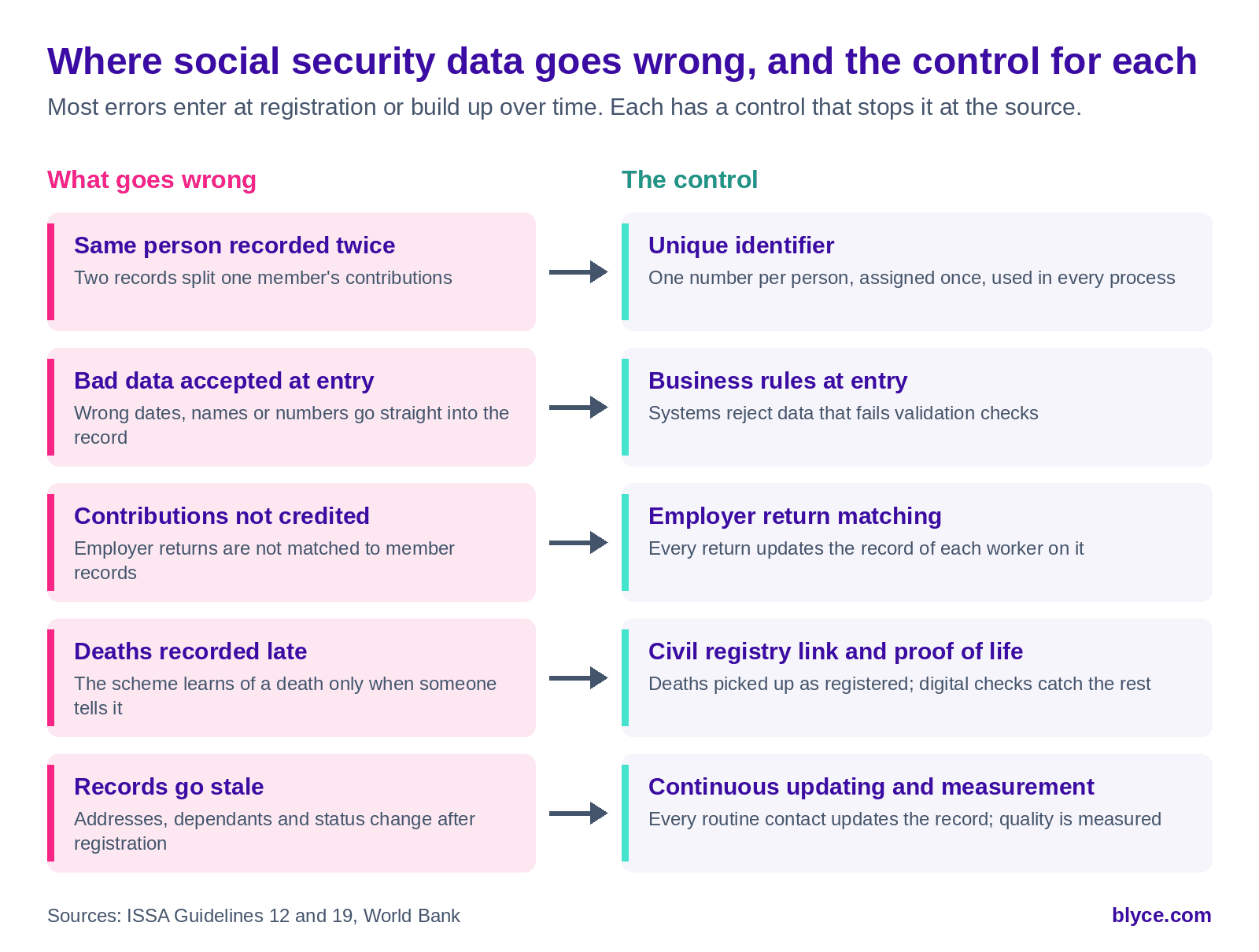
A social security number is the unique identifier that links every contribution, claim and payment to one person. Without it, the same person can appear twice, or two people can be merged into one record.
ISSA guidance allows for different options, depending on what a country already has: a national social security number, an integrated tax and social security account number, or an individual identity card number.[1] What matters is that the identifier is unique, assigned once, and used consistently across every process.
How do social security institutions keep data accurate?
ISSA guidelines describe data quality as something to be managed formally, not fixed occasionally. Its guidance on information and communication technology calls for unified, formal data quality management, with a policy adopted at board level and a framework that defines procedures and responsibilities, drawing on international practice such as ISO 8000 and DAMA-DMBOK.[5]
In practice that framework covers:[5]
- specifying data quality requirements
- profiling and assessing the quality of existing data
- writing quality rules for information systems to enforce
- correcting defects
- monitoring data quality on an ongoing basis
ISSA’s guidance on registration adds three further controls:[1]
- Quality assurance across the whole process of collecting and updating registration data, carried out by staff trained in data collection and quality control.
- Regular evaluation, comparing data over time and across sources to spot deviations.
- Cross-checking with other authorities. Where the law allows, institutions can compare their records with databases held by other bodies that collect registration information.
The last point is often the most valuable for a small institution. Matching directly against civil registration data, for example, can pick up deaths as they are registered rather than when someone notifies the scheme.
How is proof of life handled?
Many pension schemes still ask pensioners to confirm periodically that they are alive, traditionally in person or with a signed paper certificate. That places the burden on older people, and it only catches a death at the next check.
Digital proof of life is increasingly common. India’s Jeevan Pramaan service lets pensioners submit a biometric digital life certificate instead of appearing in person.[6] The United Nations Joint Staff Pension Fund reports that more than 60% of its retirees and beneficiaries submitted proof of life digitally in 2025 and 2026.[7]
Digital proof of life works best alongside data sharing with the civil registry, not instead of it. The registry catches deaths as they happen. Proof of life catches the cases the registry misses, such as pensioners living abroad.
What has to be in place for data sharing?
A legal basis, and protection for the data. The ISSA makes cross-checking with other authorities conditional on meeting legal and regulatory requirements and strict internal controls.[1] The World Bank likewise lists data protection and privacy laws, secure data-sharing arrangements and regulations that enable interoperability among the key actions for strengthening national digital delivery systems.[8]
An institution that plans to match its records against the civil registry or the tax administration should confirm the legal basis first. That may require a legal amendment or a formal agreement between agencies before any technology is involved.
What this means for a small institution
Fix the data before adding services. Online registration and self-service portals spread whatever errors are already in the database. Cleaning duplicate and outdated records first means digital services start from a reliable base.
Start with the records that pay out. Errors in the records of active pensioners and long-term benefit recipients cost money every month, so verifying those records first pays back soonest.
Connect to the civil registry. In a small state, a single link to death registration can replace much of the manual follow-up.
Make updating continuous. One-off update campaigns help, but data starts to go stale again the day they end. Updates through every routine contact, from claims to employer returns to online services, keep the record current.
Treat employer data as member data. Every employer return updates the records of the workers on it. As the Jamaican audit shows, weak tracking of employer contributions ends up as a problem for individual members.
For the wider picture of how contributions and benefits fit together, see how a social security system works.
Common questions about data integrity in social security
Because benefits are calculated from contribution records built up over a member’s whole working life. Inaccurate data can deny members benefits they have earned, through contributions that were never credited, or cause the fund to pay benefits it should not, through duplicate records or deaths that were not recorded.
Data integrity in social security means that every insured person and employer is recorded once, correctly and completely, and that their records are kept up to date throughout their lives. It covers registration, contribution records, benefit records and the link between them.
A social security number is the unique identifier that links every contribution, claim and payment to one person. ISSA guidance allows it to be a dedicated social security number, an integrated tax and social security number, or a national identity card number, as long as it is unique and used consistently.
In many schemes, through the civil registry and through notification by relatives. Institutions that depend on notification can continue paying for weeks or months after a death. Matching records directly against civil registration data narrows that gap.
Proof of life is a periodic confirmation that a pensioner is still alive and entitled to payment. It was traditionally done in person or with a signed paper certificate. A growing number of schemes offer digital proof of life, often using biometric checks through a mobile app or kiosk.
Yes, where the law allows it. ISSA guidance supports cross-checking records with other authorities that collect registration information, provided legal and regulatory requirements and strict internal controls are met.
Continuously. ISSA guidance treats data quality as something to be measured on an ongoing basis, with quality rules built into information systems, rather than corrected through occasional clean-up exercises.
Footnotes
[1] Guideline 12. Implementing data quality assurance mechanisms, ISSA Guidelines, Administrative Solutions for Coverage Extension
[2] Over half of NIS claims records requested for analysis not produced: audit, Stabroek News, May 2016
[3] Auditor General’s Department Annual Report 2019/2020: Ministry of Labour and Social Security, National Insurance Scheme, Auditor General’s Department of Jamaica, December 2020
[4] Frequently asked questions, National Insurance Scheme of Barbados, 2022
[5] Guideline 19. Data quality management, ISSA Guidelines on Information and Communication Technology
[6] Jeevan Pramaan: the digital solution for annual life certificate for pensioners, Amrita Vishwa Vidyapeetham, eGov case study
[7] UNJSPF highlights digital identity innovation at WSIS Forum 2026, United Nations Joint Staff Pension Fund, July 2026
[8] Digital delivery systems, World Bank, last updated September 2026
Blyce builds social security and benefit administration systems for small states.
