
Most people encounter social security twice: once when a deduction appears on their payslip, and once when they need something back.
What happens in between is one of the most complex administrative operations any government runs. It is also one of the least understood.
This guide explains how a social security system actually works, not as software, and not as policy theory, but as a working programme: who it covers, where the money comes from, how an entitlement is built over a lifetime, and how a claim becomes a payment.
Every national system differs in its rules. The architecture underneath them is remarkably consistent.
Understanding that shared architecture is what allows any government, in any country, to assess whether its own system is doing what it was designed to do.
What Is a Social Security System?
A social security system is a set of publicly mandated programmes that protect people against defined risks across their lifetime, funded collectively and administered under the general responsibility of the state.
The International Labour Organization codified this definition in the Social Security (Minimum Standards) Convention, 1952 (No. 102), which remains the only international treaty that frames social security in a complete, systemic way.
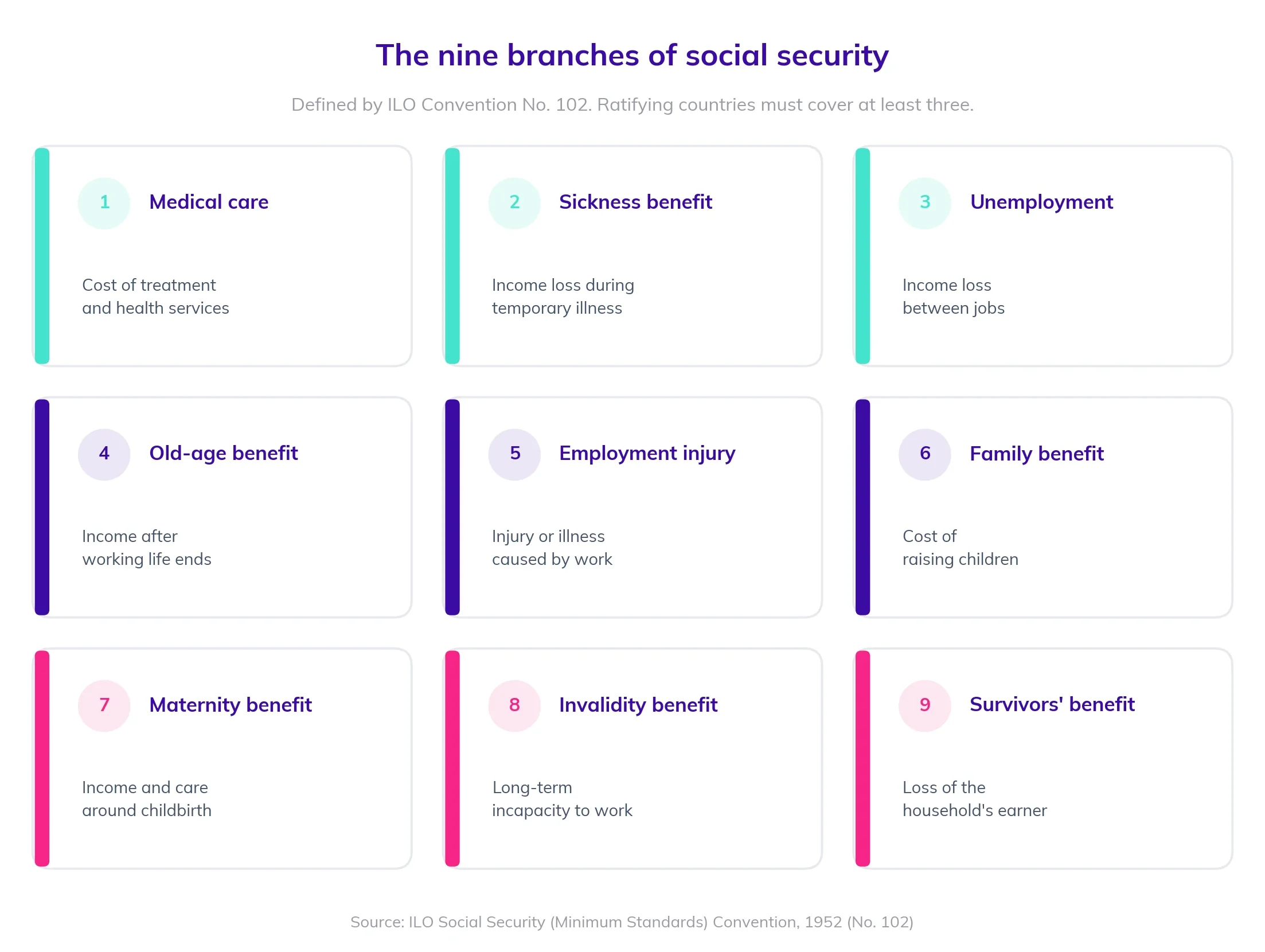
Convention No. 102 identifies nine branches of social security, each corresponding to a contingency people face during their lives:
| Branch | The risk it addresses |
|---|---|
| Medical care | Cost of treatment and health services |
| Sickness benefit | Income loss during temporary illness |
| Unemployment benefit | Income loss between jobs |
| Old-age benefit | Income after working life ends |
| Employment injury benefit | Injury or illness caused by work |
| Family benefit | Cost of raising children |
| Maternity benefit | Income and care around childbirth |
| Invalidity benefit | Long-term incapacity to work |
| Survivors’ benefit | Loss of the household’s income earner |
No country is required to cover all nine at once. Convention No. 102 requires ratifying states to accept a minimum of three branches, allowing systems to expand progressively as national capacity grows.
This is why comparing two countries’ systems can be misleading. A system covering three branches well may be functioning exactly as designed, while a system nominally covering nine may be failing at all of them.
"Access to at least a basic level of social security throughout the life cycle is a human right, fundamental to ensuring individuals' health and dignity."
International Labour Organization
The 5 stages every Social Security system runs
Whatever branches a country covers, and whatever the local rules, every social security system performs the same five operations in sequence.
- Registration identifies who is in the system
- Contribution brings money in
- Entitlement accrues over time as a record
- Claim converts a life event into an assessment
- Payment delivers the benefit
A failure at any one stage compromises every stage after it. The sections below take each in turn.
Stage 1: Registration, or who the system knows about
Before a system can protect anyone, it has to know they exist.
Registration establishes a person’s identity within the scheme and links them to a unique record that will follow them for the rest of their life. In most countries, three parties trigger registration:
- Employers, who must register their business and enrol each employee, usually within a fixed period of hiring
- Self-employed individuals, who register directly and take on both sides of the contribution obligation
- The institution itself, which may register residents automatically for non-contributory or universal schemes
This stage is where the largest failure in global social security occurs. Registration depends on formal, documented employment relationships, and a substantial share of the world’s workforce does not have one.
The consequence is measurable. According to the ILO’s World Social Protection Report 2024–26, 52.4 per cent of the world’s population is now covered by at least one social protection benefit, up from 42.8 per cent in 2015.
That milestone means slightly more than half of humanity is inside a system. It also means the right to social security is not yet a reality for 3.8 billion people.
The gaps are uneven. Just over a third of the working-age population contributes to a pension scheme. More than two-thirds of children globally, some 1.5 billion, receive no social protection cash benefit at all.
A person who is not registered is not merely unpaid. They are invisible to the system, and no downstream process can correct for that.
Stage 2: Contributions, or where the money comes from
Social security is financed collectively. Convention No. 102 establishes collective financing, through insurance contributions or taxation, as a core principle of any compliant system.
In practice, financing takes three forms, and most countries operate a mix.
Contributory schemes (social insurance) are funded by regular contributions from workers, employers, and often the state. Entitlement is earned through a contribution record. This is the dominant model for old-age pensions, sickness, maternity, and unemployment benefits.
Non-contributory schemes (social assistance) are funded from general taxation and paid on the basis of need or residence rather than contribution history. Non-contributory old-age pensions are the most common example, covering people who never accumulated a sufficient contribution record.
Universal schemes provide a benefit to everyone in a defined category, such as all residents over a certain age, regardless of contribution or means.
In a contributory system, the contribution is typically calculated as a percentage of insurable earnings, shared between employer and employee, and applied between a lower and an upper earnings limit.
The employer normally withholds the employee’s share and remits both together. The specific rates, limits, and split are set in national legislation and differ considerably between countries.
That mechanism is the reason contribution collection is an enforcement function, not an accounting one. The institution is dependent on employers to declare accurate wages and remit on time. Where declarations are understated or remittances are late, the shortfall does not surface immediately. It surfaces years later, in the entitlement record of a worker who did nothing wrong.
Stage 3: Entitlement, or how rights accumulate over a lifetime
This is the stage that distinguishes social security from almost every other government service, and it is the one most often misunderstood.
A tax administration is concerned with a period. A social security institution is concerned with a lifetime.
Every contribution paid on a person’s behalf is recorded against their individual account. Over decades, those records accumulate into a contribution history, and it is that history, not the person’s current circumstances, that determines what they are entitled to receive.
Entitlement typically depends on:
- Qualifying periods, a minimum number of contributions before a benefit can be claimed at all
- Contribution density, how consistently contributions were made across the working life
- Reference earnings, the wage level on which contributions were based, which usually determines benefit value
- Continuity rules, which govern what happens during gaps caused by unemployment, illness, caregiving, or migration.
The practical implication is severe. An error entered into a contribution record in one year may not produce a visible consequence until a claim is made thirty years later, at which point the employer may no longer exist, the documentation may be gone, and the person affected has no way to reconstruct what happened.
A social security system is, at its core, a longitudinal data trust. The institution is holding a record on behalf of a citizen that will be honoured decades after it was created. Everything else the institution does depends on that record being complete and correct.
Stage 4: Claims, or turning a life event into an assessment
A claim begins when a contingency occurs: a person reaches pension age, gives birth, is injured at work, falls ill, loses a job, or dies leaving dependants.
The institution must then answer a sequence of questions, in order:
- Is this person registered and identifiable?
- Has the contingency actually occurred, and is it evidenced?
- Does their contribution record satisfy the qualifying conditions for this branch?
- What benefit amount do the rules produce for this record?
- For how long is the benefit payable, and under what conditions does it stop?
Each question is governed by legislation, and the answers are rarely simple. Eligibility rules interact with each other, with employment status, with residence, with family composition, and with other benefits the person may already receive.
This is where two distinct failure modes appear, and confusing them leads to poor policy.
Error is the system reaching the wrong answer through mistake: a miscalculated qualifying period, an outdated wage record, a rule applied incorrectly.
Fraud is deliberate misrepresentation: undeclared work while receiving unemployment benefit, unreported death of a pensioner, falsified medical evidence.
They require opposite responses. Error is reduced by better records, clearer rules, and consistent application. Fraud is reduced by verification and cross-checking against independent data. Treating error as fraud punishes people for institutional mistakes. Treating fraud as error leaves the system exposed.
There is a third failure that is easier to overlook because nobody complains about it. Exclusion error occurs when someone entitled to a benefit never receives it, because they did not know it existed, could not complete the process, or was wrongly refused. It produces no appeal, no case file, and no visible cost, while quietly defeating the purpose of the programme.
Stage 5: Payment, and why timing is the real measure
The final stage converts an approved assessment into money in a person’s hands.
The mechanism matters less than the reliability. Whether payment arrives by bank transfer, mobile money, or over a counter, the operational test of a social security system is not whether it eventually pays. It is whether it pays the right amount, to the right person, on the expected date, every cycle.
This is a different standard from most public services. A delayed permit is an inconvenience. A delayed pension is a household without food that week. The people most dependent on social security benefits are, by definition, those with the least capacity to absorb a delay.
Payment is also where systems reveal whether their earlier stages worked. Every payment made to the wrong person, at the wrong amount, or after the wrong delay traces back to a failure in registration, contribution, entitlement, or assessment. The payment stage does not create errors. It exposes them.

Why coordination determines whether the system works
The five stages describe how one benefit operates. Real systems run many benefits at once, and this is where administration becomes genuinely difficult.
A single citizen may simultaneously be an employee contributing to a pension, a parent receiving family benefit, a patient using national health insurance, and a taxpayer. Each relationship may sit in a different register, governed by different legislation, held by a different institution.
Only 60.1 per cent of the world’s population is affiliated to a publicly mandated programme guaranteeing affordable access to health care, which means health and income protection frequently sit in separate systems even for the same person.
When those registers do not reconcile, three consequences follow:
- The citizen is asked repeatedly for information the government already holds, usually at the moment they are least able to provide it
- Inconsistencies remain invisible, because no single view exists in which a contradiction could appear
- The institution cannot forecast, because it cannot see the whole population it is responsible for
That last point is the strategic one. Social security is a long-term financial commitment made under demographic uncertainty. Convention No. 102 requires regular actuarial valuations precisely because sustainability depends on projecting obligations decades forward.
An institution that cannot state with confidence how many people are contributing, how many are receiving, and how those numbers are trending cannot perform that projection. It is managing a multi-decade liability on incomplete information.
The pressure every system now faces
Three forces are converging on social security institutions at the same time.
Populations are ageing. Pensions are already the most widespread form of social protection, yet 165 million older people still receive no benefit at all.<sup>[4]</sup> As life expectancy rises, the same contribution base must support a longer and larger benefit obligation.
Work is becoming less formal. Platform work, short-term contracts, and self-employment do not fit contribution models built around a stable employer relationship, and coverage gaps follow directly from that mismatch.
Expectations have risen. Citizens who transact instantly with banks and mobile providers increasingly apply the same standard to the institution holding their contribution record.
None of these are administrative problems in origin. All of them become administrative problems in practice, because the institution absorbs the consequences of each.
What this means for governments
A social security system is not a payments operation with a database attached. It is a lifetime record-keeping obligation with a payments function at the end of it.
That framing changes what matters:
- The contribution record is the asset. Its completeness determines whether the system can honour commitments made decades earlier.
- Fragmentation is the primary risk. Benefits administered in isolation cannot be reconciled, and unreconciled data conceals both error and fraud.
- Administration is policy. A benefit that exists in legislation but cannot be reliably delivered does not exist for the person entitled to it.
- Coverage is the outcome measure. Countries allocate 19.3 per cent of GDP on average to social protection including healthcare, yet only 52.4 per cent of the world is protected by at least one benefit. The gap between expenditure and reach is where administration either succeeds or fails.
Governments that treat social security administration as a back-office function tend to discover its importance at the worst possible moment: when a payment cycle fails, when an actuarial review reveals an unfunded obligation, or when a citizen who contributed for thirty years cannot prove it.
The systems that work are the ones where registration is complete, contributions are verified, records are continuous, assessments are consistent, and payments arrive on the day they are expected. Everything else is commentary.
Frequently Asked Questions About Social Security Systems
Social security is the broader term for publicly mandated protection against defined life risks. Social assistance is one way of financing it, funded from general taxation and granted on the basis of need or residence rather than a contribution record. Social insurance, the other main model, is funded by contributions and grants entitlement based on contribution history.
In most contributory systems, contributions are a fixed percentage of insurable earnings, split between employer and employee, and applied between a minimum floor and a maximum ceiling. The employer usually withholds the employee’s share and remits both to the institution. Exact rates, floors, and ceilings are set in national legislation and vary considerably between countries.
Under ILO Convention No. 102, the nine branches are medical care, sickness benefit, unemployment benefit, old-age benefit, employment injury benefit, family benefit, maternity benefit, invalidity benefit, and survivors’ benefit. Ratifying countries must cover at least three.
Non-contributory social security schemes exist to cover people who never accumulated a sufficient contribution record, often because they worked informally, performed unpaid care work, or were unable to work. These schemes are funded from general taxation rather than contributions, and non-contributory old-age pensions are the most widespread example.
A qualifying period is the minimum contribution history a person must have before they can claim a particular social security benefit. It prevents someone from contributing briefly and immediately drawing a long-term benefit, and it varies by branch. Old-age pensions typically require the longest qualifying periods.
Because social security entitlement is built over a lifetime rather than assessed at the moment of need. The contribution record determines both whether a person qualifies and how much they receive. An error recorded early in a working life may not surface until a claim is made decades later, when the evidence needed to correct it may no longer exist.
Footnotes
[1] Social Security (Minimum Standards) Convention, 1952 (No. 102) — International Labour Organization
[2] Frequently Asked Questions: Convention No. 102 — International Labour Organization
[3] World Social Protection Report 2024–26 — International Labour Organization
[4] World Social Protection Data Dashboards — International Labour Organization
[5] The ILO Social Security (Minimum Standards) Convention, 1952 (No. 102) — International Labour Organization
[6] International Labour Standards on Social Security — International Labour Organization
